Which area is your biggest bottleneck right now?
While I absolutely love hearing success stories, I often favor takeaways from failure and the iteration ideas that stem from mistakes.
The first question I often hear in these conversations is:
How can we find product-market fit without spending months building something no one uses?
The answer they uncovered, and the one every founder need to internalize is:
You don’t build an MVP to launch. You build it to learn.
There’s a huge difference between an MVP that ships and an MVP that teaches you something real.
In the traditional playbook, teams obsess over features.
In the AI-native playbook, we obsess over feedback loops.
Why the MVP Matters — But Only If You Learn from It
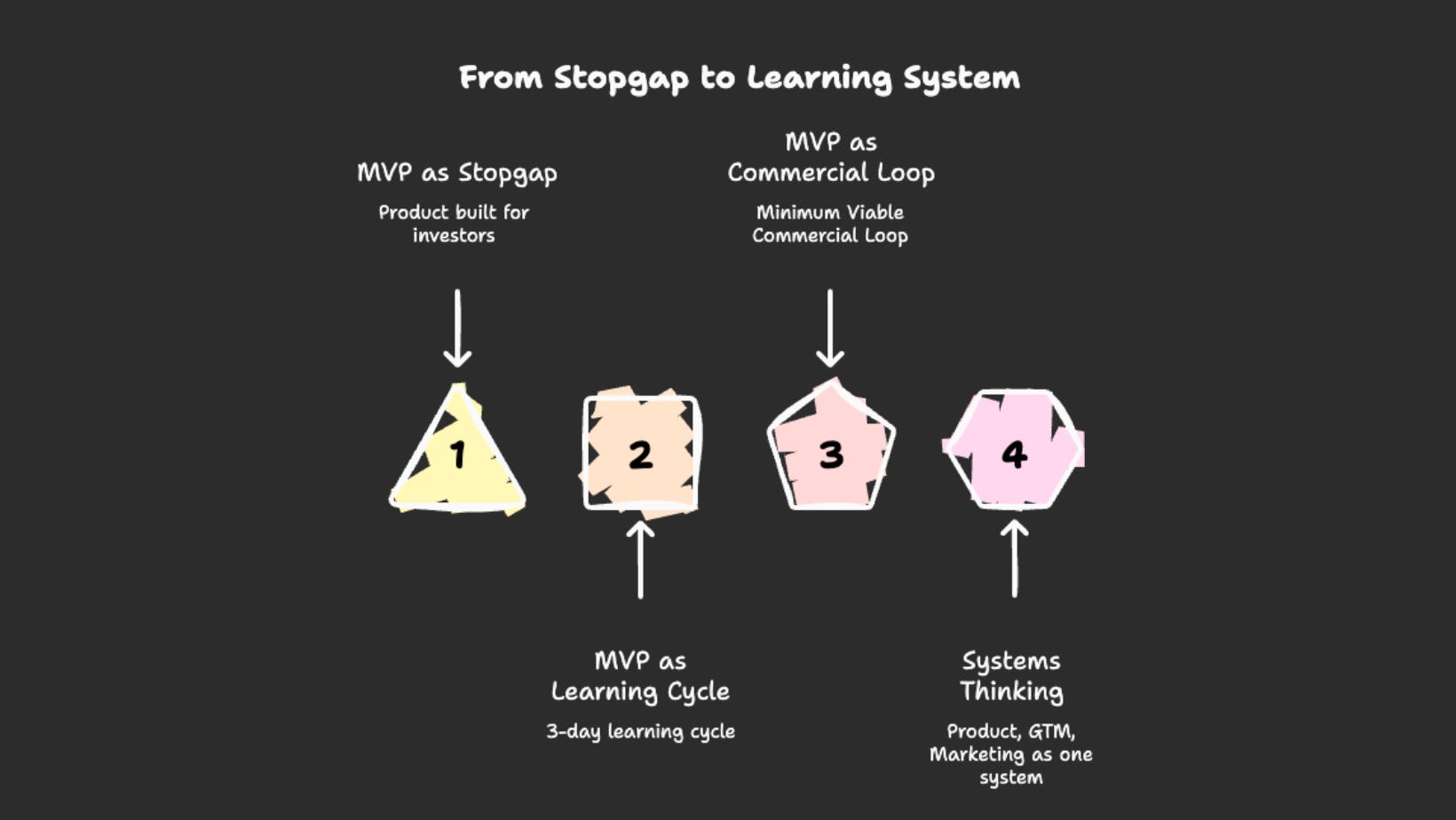
Most founders treat MVPs as a stopgap product: something to show investors, something to demo.
But here’s the reframing:
An MVP is a 3-day learning cycle, not a milestone.
MVP ≠ minimal product
MVP = Minimum Viable Commercial Loop.
Most founders and cross-funtional teams at enterprises treat:
Product as build
GTM as launch
Marketing as amplification
Here’s the systems / loops thinking:
Product, GTM, and Marketing are one continuous learning system.
During my recent session with a founder-PM team:
They built their first MVP in 3 days.
They shipped it to real users.
Day 4, they had actual behavior data — not assumptions.
Day 6, they were already iterating based on what users actually did.
That kind of speed is not accidental, it’s systematic.
It’s the sort of repeatable loop that prevents product failure, tightens GTM execution, and surfaces truth fast.
In 2026, the learning loop must include:
Product usage signal
Distribution signal
Conversion signal
Retention signal
If GTM is not embedded in the loop, you are only validating functionality, not commercial viability.
Product without GTM integration is a technical experiment.
Product with GTM integration becomes a commercial system.
The Core Shift: From Perfection to Signal
Traditional mindset:
Feature completeness → user delight → successAI-native mindset:
Signal strength → rapid iterations → product-market alignment.Here’s how they differ in practice:
Old Playbook: “We need our product to be feature-complete before we ship.”
AI-Native Playbook: “We need real user actions before we build the next feature.”
This shift changes the entire execution model.
Rather than sinking months into design specs, you’re asking:
What is the smallest version of this that produces meaningful user behavior?
What signal will tell us if we’re on the right path?
How quickly can we learn from real use, not opinions?
Speed is Not Chaos; It is Your Learning Velocity
Moving fast doesn’t mean moving recklessly.
In fact, speed, when structured, reduces risk.
Here’s why:
Quick shipments shorten feedback loops.
Real user behavior beats guesses every time.
AI analytics lets you interpret signal instead of noise.
A 3-day cycle is not an approximation, it’s a learning cadence that outperforms long planning cycles.
From one sprint you learn:
who interacts,
what they struggle with,
what drives engagement,
what drives abandonment.
That’s the data you use to decompose failure early, not after six months of mistakes.
AI, Feedback, and the Learning Loop
AI becomes transformational here not as a toolset, but as a sensory system.
Build → Signal → Adjust → Redistribute → Reposition → Rebuild.Instead of waiting for manual surveys, focus groups, or guesswork, AI lets you:
monitor user paths,
map behavior intent,
interpret engagement patterns,
surface feature impact in real time.
That turns your MVP into:
1. a testing engine
2. a growth signal generator
3. and ultimately, a validation system.
This is how you close the feedback loop instead of leaving it open.
The Uncomfortable Truth
Most products don’t fail because the idea was bad.
They fail because the feedback loop was too slow.
You waited weeks, months, or quarters to learn what your users truly wanted.
Meanwhile:
the market evolved,
competitors moved,
users lost interest.
AI-native systems short-circuit that delay.
Next Week: The Silent Silo That Kills GTM
In our next issue, we’ll explore:
Why product management and founder misalignment kills your GTM execution, and how AI-native collaboration patterns fix it.
If you want to break through execution silos and build a system where product and growth speak the same language, you’ll want to read that.
Until then, think in loops, not lists.
Grace Man
Founder, AI Strategy League | ex-Microsoft