Your feed is full of AI content now.
You use AI every day, and the draft still does not sound like you, and you rewrite the whole many parts of the copy, and yet not driving enough quality pipeline, closing revenue.
That is the gap I want to close.
The gap between AI that sounds like AI, and content that sounds like you and actually converts.
Sounding like you is not a style. It is a strategy.
It is your point of view, your real words, and who you are for.
The agent just runs it at velocity, with you as the only approval gate.
Here is the line I want you to keep. AI can copy your words. It cannot copy your point of view.
Your point of view is the product, and the agent is just how you ship it fast, in your voice, with you as the gate.
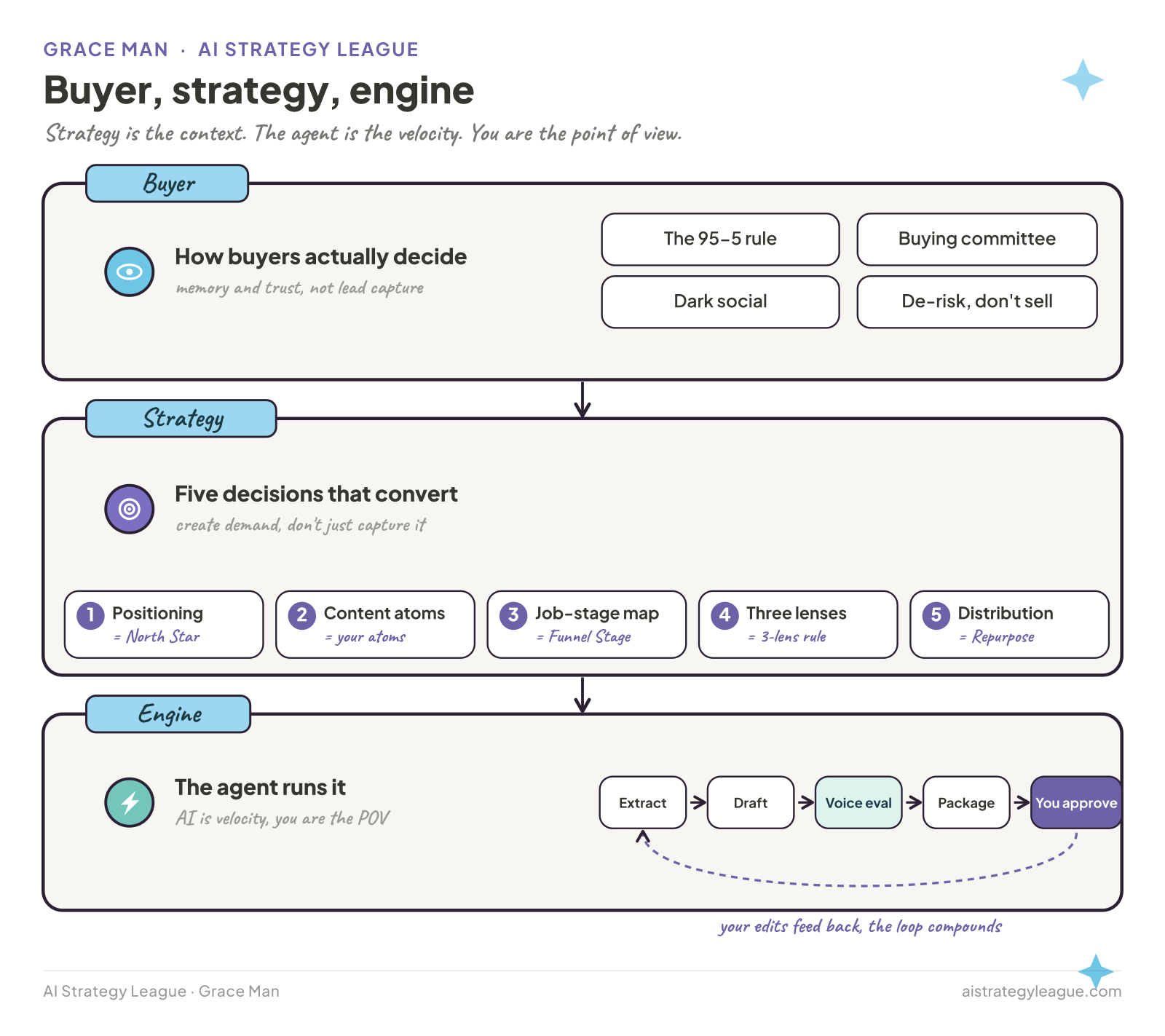
The whole thing sits on one picture. Buyer, Strategy, Engine.
Understand how buyers decide.
Decide what to say and why it converts.
Then run it through an engine that drafts, evaluates, and never sends without you.
Understand how buyers decide, decide what to say and why it converts, then run it through an engine that drafts, evaluates, and never sends without you.
How B2B buyers actually decide now
You cannot write content that sounds like you and converts until you accept who you are writing for, and what state they are in. Five truths, each one changes what you make.
The 95-5 rule.
Only about 5% of your market can buy this quarter, no matter how good your call to action is. The other 95% cannot yet. So stop just aiming every post at the 5%.
95% percent is the purple sea, while the remaining 5% is the red sea.
Content strategy should also focus on the 95% who aren’t ready to buy yet, because that’s where trust, memory, and the pipeline you’ll close next year are built.
The buying committee.
You are not convincing one person. Six to ten stakeholders each research alone and must agree internally before they agree with you.
So write what your champion can forward to sell you when you are not in the room, not just a pitch aimed at them.
Dark social.
67% of buyers prefer to buy rep-free. They form their opinion in the feed, in Slack, and on podcasts, before they ever reach your site. So stop optimizing the last click. Be present and quotable where the decision actually happens, off your own site, where your CRM cannot see it.
De-risk, do not sell.
A B2B purchase is a career-risk decision for the person who champions it internally. Clever does not convert, safe-to-choose does. Lead with proof, specifics, and a clear point of view so picking you feels like the low-risk call.
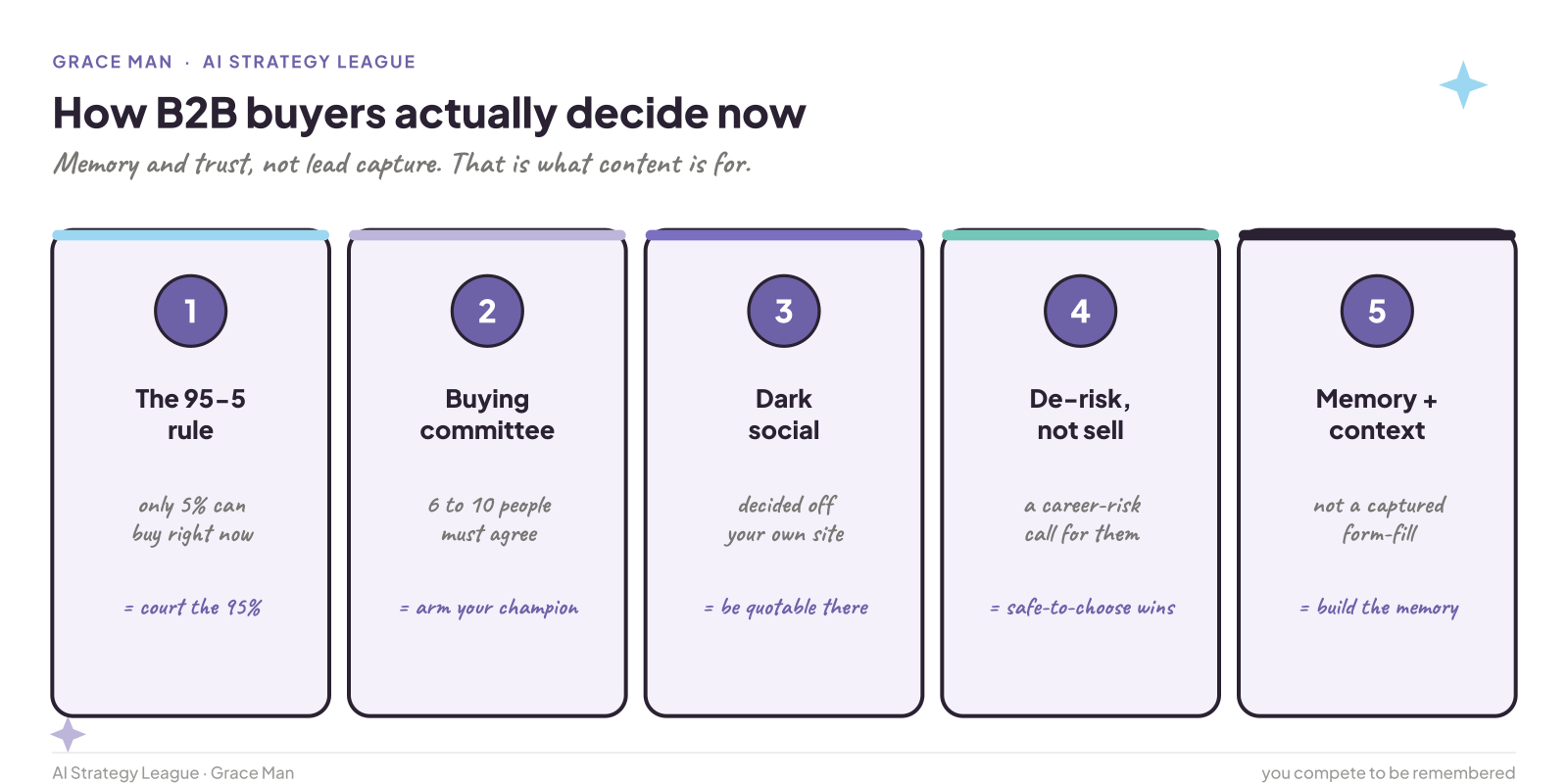
Memory and context, not capture.
And here is the one that ties the whole thing together. Buyers decide on memory and trust, not a captured form-fill.
This is the same principle you use to build an agent. You give Claude memory and context so it understands you and produces work that sounds like you. You do exactly the same for your buyer.
Build a memory layer with them.
Content is the context and memory that makes you familiar and trusted over time, so they arrive ready to buy, not cold.
Do not just capture a lead and hope it converts.
Build the memory, and the trust compounds, the same way context makes an agent better every time it reads it.
So the job of content is not to just capture a lead. It is to be remembered and trusted by the 95% who cannot buy yet.
And you get remembered by having a point of view, in a voice they recognize. That is what sounding like you is actually for. You are not competing for a sale today. You are competing to be remembered on the day the buyer is finally allowed to buy.
Five decisions that make content sound like you and convert
Five decisions, in order. Each one is a decision the agent then executes, but the decision is yours, and it is where the leverage is.
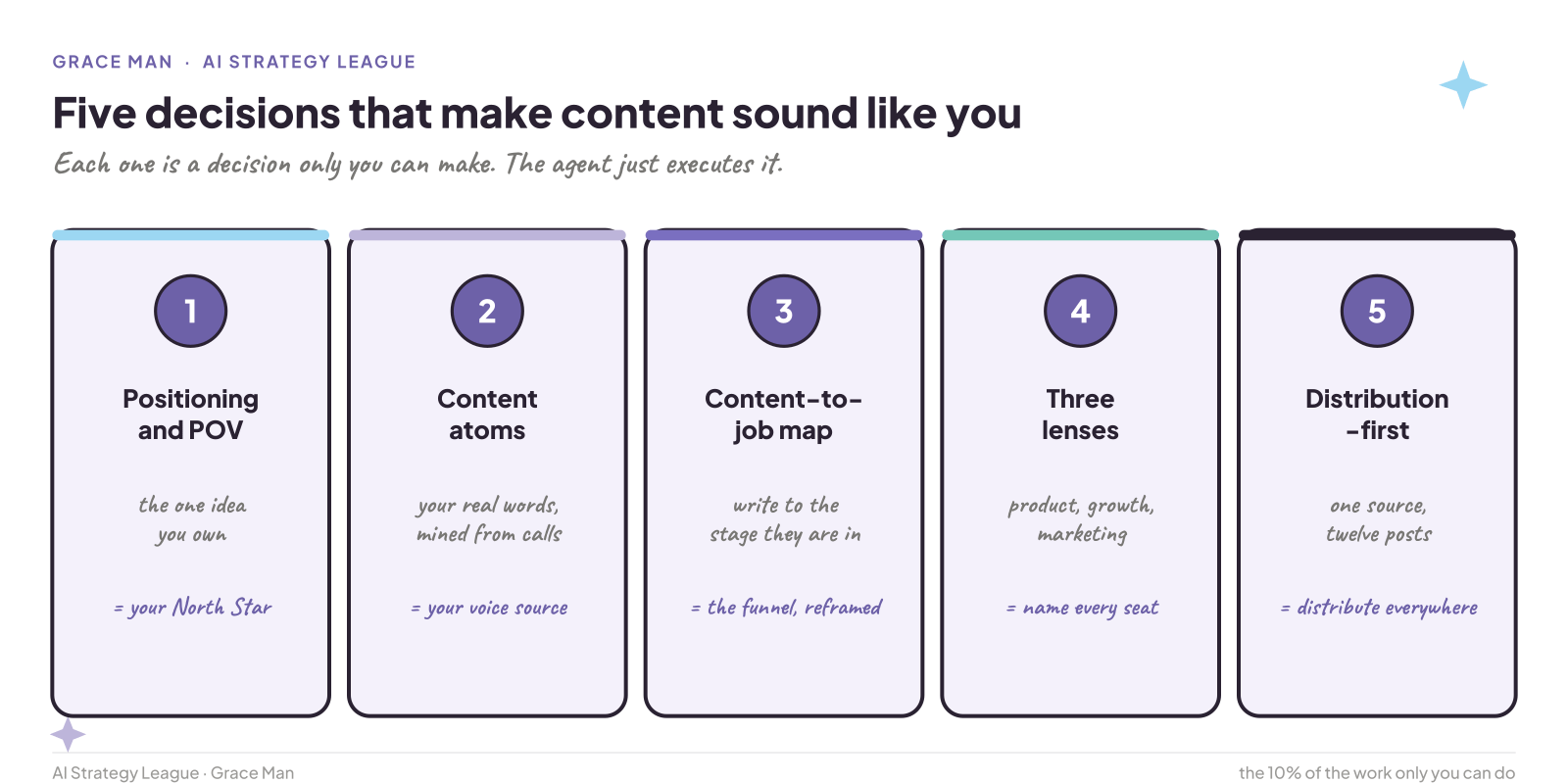
Positioning and point of view.
Decide the frame before you write a single post, because the same expertise is forgettable in one frame and magnetic in another.
Run the positioning pass once, your competitive alternative, your one unique attribute, the value it unlocks, who cares most, the category you own, then compress it to one point of view you repeat until you are known for it.
It converts because every piece ends on an opinion, not a generic tip, and an opinion is the one thing an AI cannot copy from you.
Content atoms.
Do not invent topics from a keyword tool.
Mine your real conversations for the exact things buyers say. The recurring question, the objection they push back with, the line worth quoting.
Pull eight to twenty of these atoms from your last three calls or threads. It converts because atoms carry the buyer’s own language, and that is what makes content land and actually sound like you, your real words instead of a style prompt.
The content-to-job map.
Write to the job the buyer is doing and the stage they are in, not a linear funnel.
Trust for the 95%, discovery, conversion for the 5%, and retention.
It converts because you meet the buyer where they actually are, and you publish a Trust piece and a Conversion piece in the same week, since your audience sits at every stage at once.
The three lenses.
You sell to a committee, so every piece leads with one lens and names the other two. Product, growth, and marketing.
It converts because naming the seat makes each stakeholder feel the piece was written for them, which is exactly what your champion needs in order to forward it.
One primary lens per piece, all three across a month.
Distribution-first.
Plan the fan-out before you write, because the pillar is the quarry, not the finished product.
One source becomes one newsletter, one long post, and ten short pieces native to each channel, pushed into the feeds where the 95% actually spend their time. It converts because reach compounds when you spend more time distributing than creating.
Decide the atomisation first, then write once and distribute everywhere.
None of this is a prompt. These are decisions only you can make. That is the 10% of the work that matters. The agent does the other 80.
Workshop: Build Growth Agents in Claude Code → Sign up here
We’ve now added a voice evaluation agentic workflow to the growth content agent build in Claude Code. Learn how to evaluate whether your content sounds like you.
Looking for 1:1 support to co-build your growth system and agent team?
Explore Strategy + Co-Build Agentic Growth OS, or book a call
The agent makes you faster. It does not make you worth reading. That part is still yours.
That’s it for this week.
See you next time.
Grace Man,
AI Strategy League | Ex-Microsoft