Set up and run one growth agent team
Go-to-market moves in spikes. A launch, a post, then silence, and the grind lands back on you. Product, growth, and marketing each run their own scramble, with their own tools, and nothing compounds because no one decided who does what and who reviews.
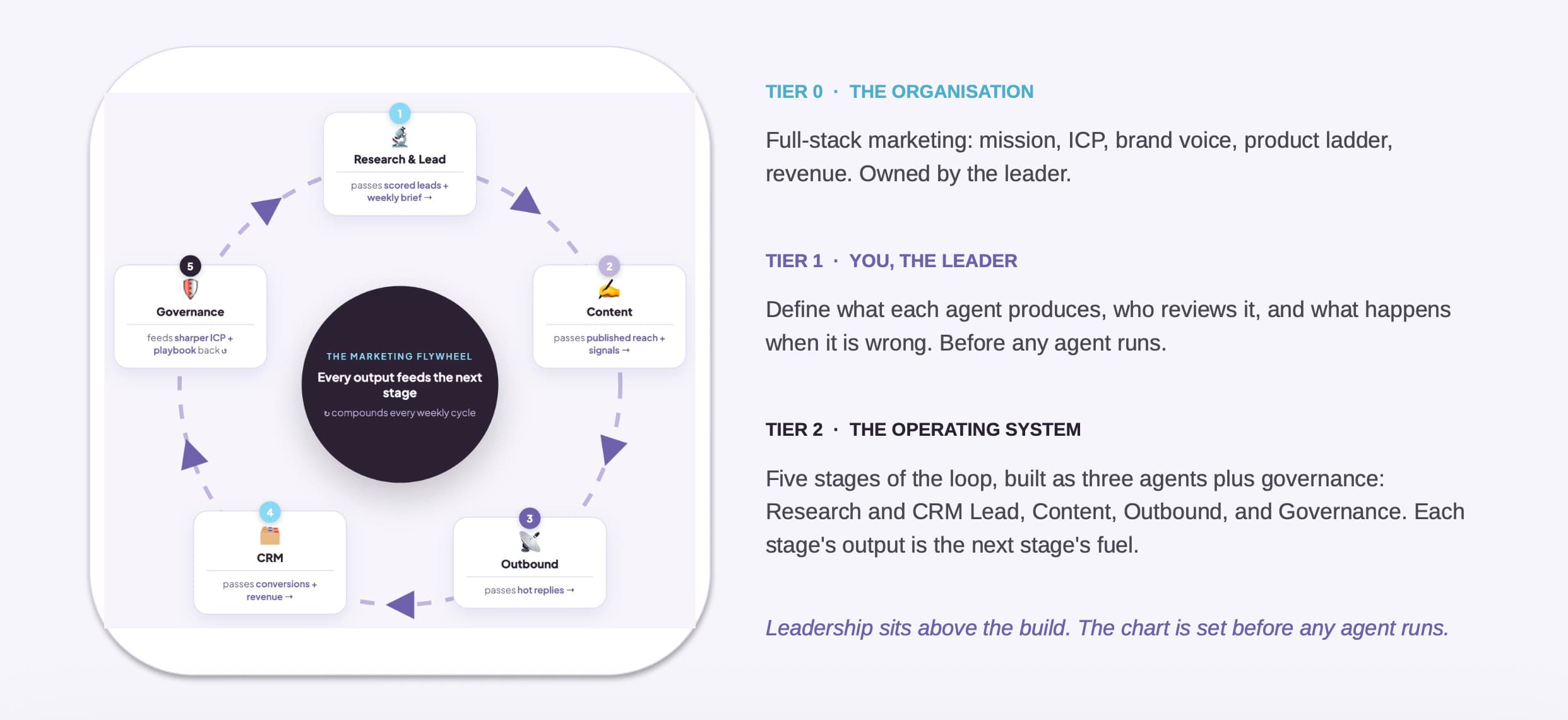
Here is the whole system I teach, in one picture. Go-to-market is really three seats:
product owns the signals and the roadmap
growth owns pipeline
marketing owns demand.
This is how you run all three as one team. It is the agentic growth flywheel, one system that compounds: research feeds content, content feeds outbound, and the replies feed back to research. The wheel turns, and each turn makes the next one easier. What is new is that it now runs as one named team, on one shared memory, with the MAPE framework as its engine. This is exactly what you set up in the upgraded workshop this July, live, on your own account.
MAPE is the engine inside every turn
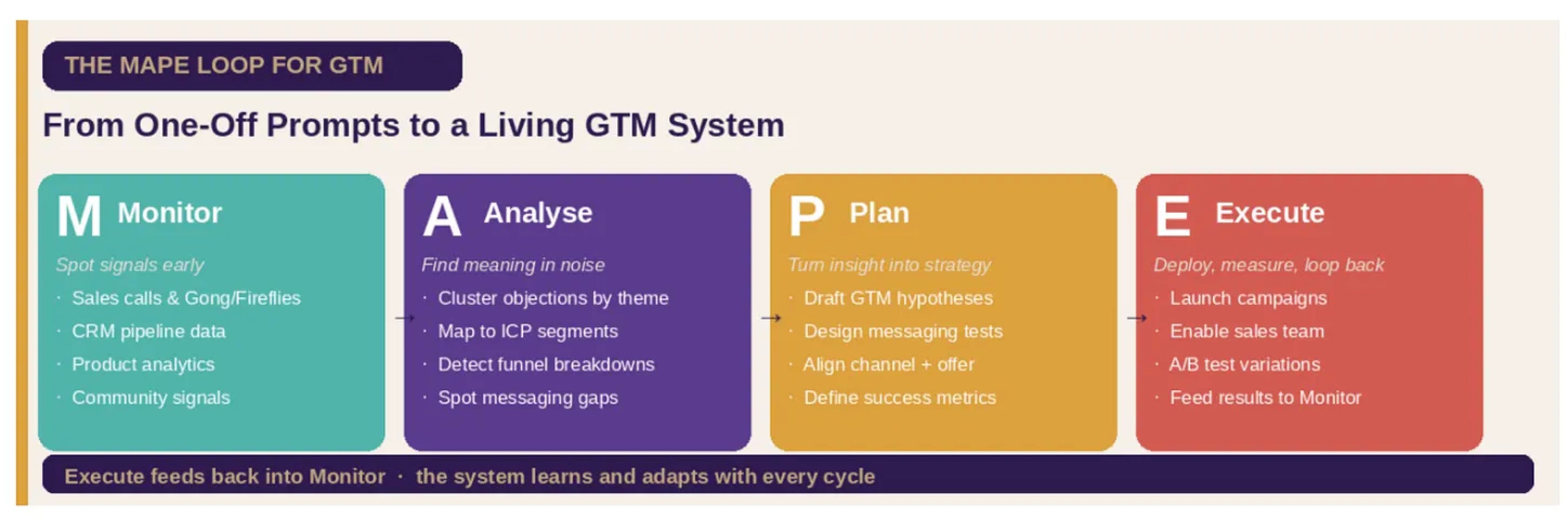
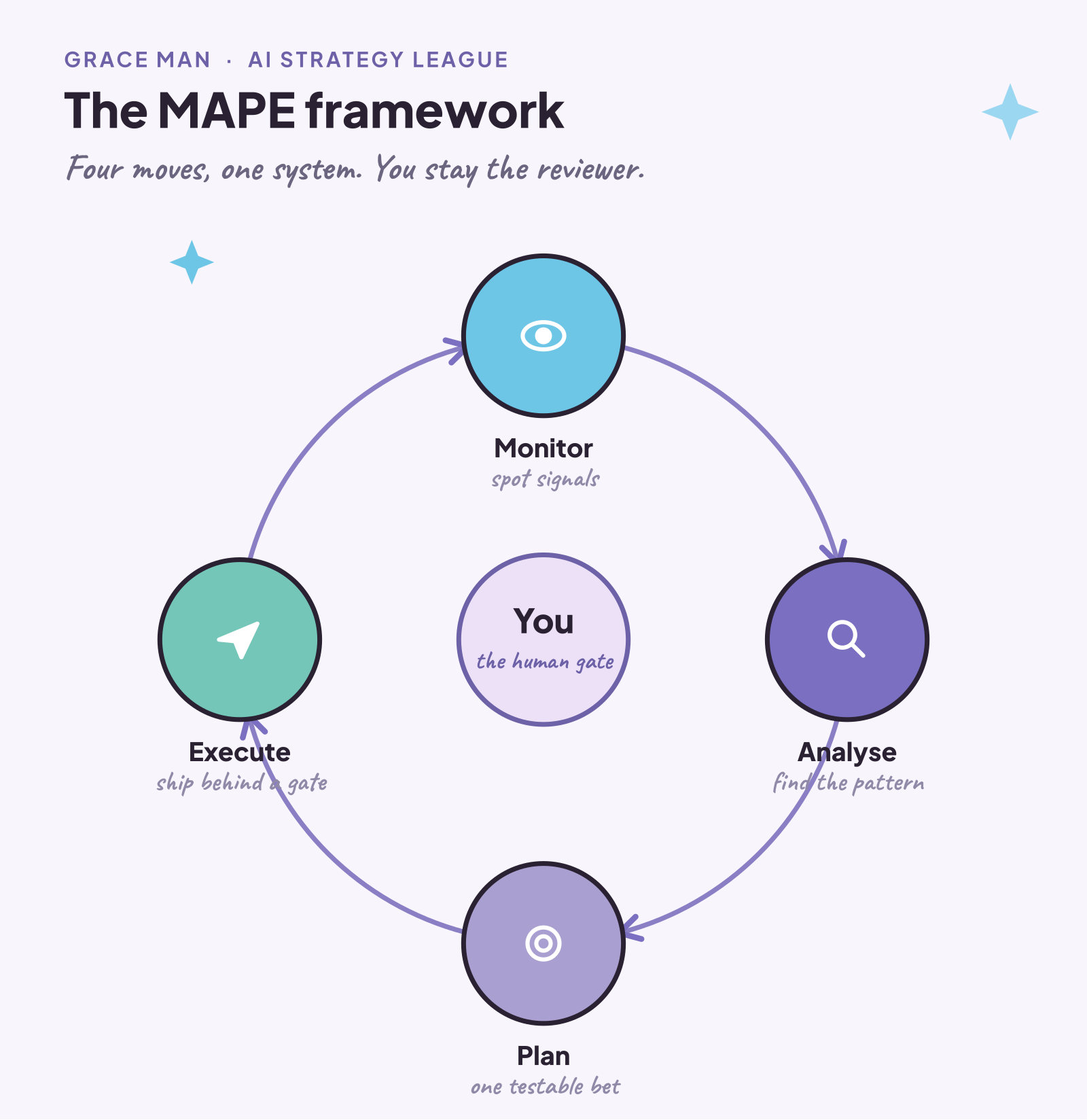
Every turn of the flywheel runs the same four moves.
This is the MAPE framework, and it is what the agents actually do:
Monitor the signals.
Analyze what they mean.
Plan the one move worth making.
Execute it, behind your approval.
Name your agent team that runs MAPE
Give each MAPE move an owner, and the framework becomes a team you can see:
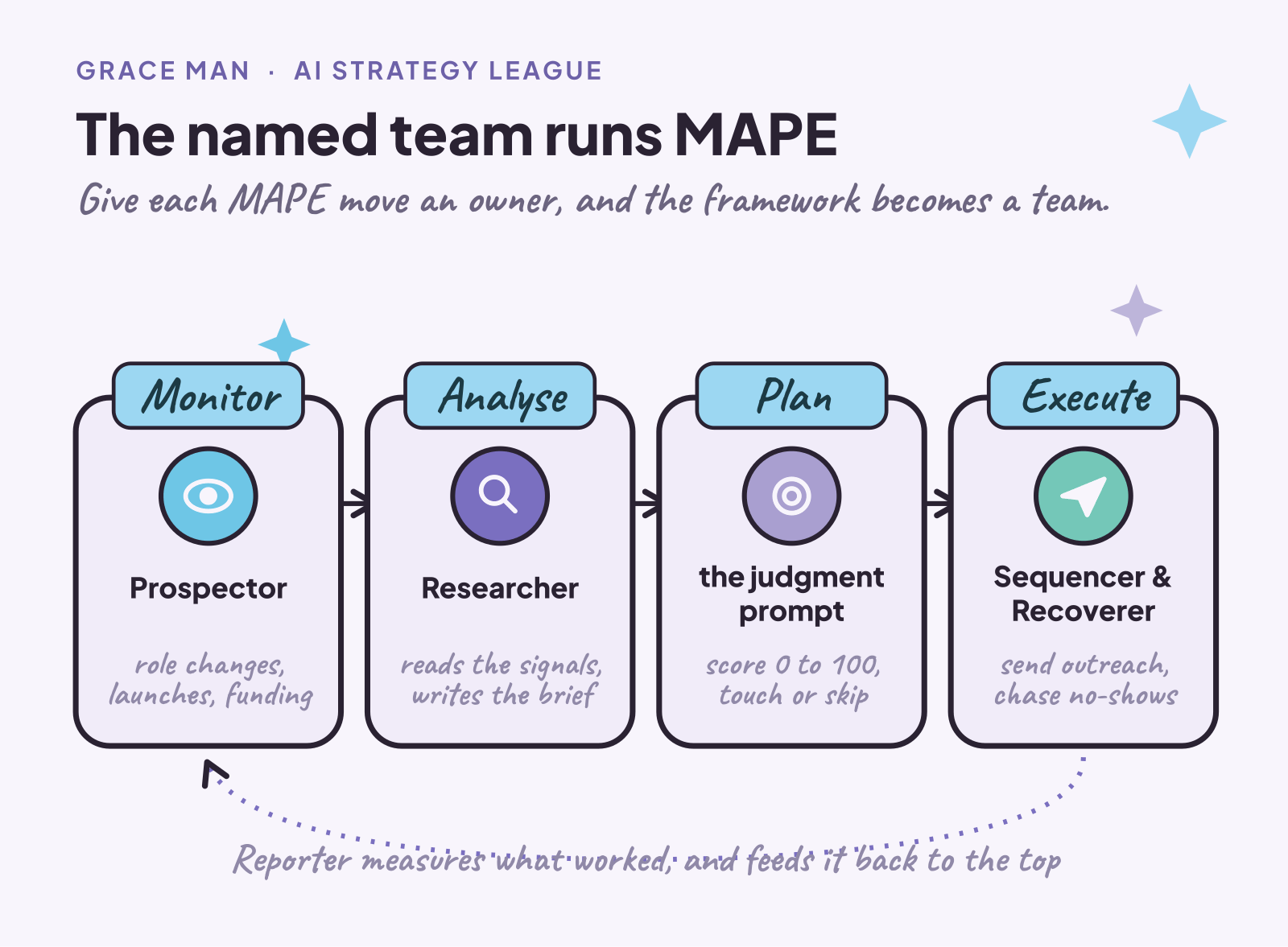
Prospector monitors the signals: role changes, competitor moves, launches, funding.
Researcher analyses them and writes the brief.
The judgment prompt plans the call: score the account 0 to 100, then first touch, follow up, nurture, or skip.
Sequencer and Recoverer execute the outreach and chase the no-shows.
Reporter measures what worked and feeds it back to the top of the wheel.
Content sits in the middle, writing in your voice.
That is the flywheel, the MAPE engine, and the named team, one system. In the workshop, you set this team up yourself, live, in three hours, with no code.
One shared memory makes them a team
Every agent reads and writes one source of truth, one record per account. That is the difference between five clever prompts and a team that coordinates.
You run it in two minutes
The team works before you start, then surfaces as one morning standup. You spend two minutes: approve, edit, or kill. That is the whole operating cost of the team.
Setup beats prompting
Here is the part most people miss. The gap between using Claude Code like an amateur and running it like an operator is not better prompts. It is setup. The best users do not re-prompt every time. They build their context once, then reuse it. A saved prompt is a sticky note. A skill is a prompt that knows when to fire and how to do the job well, every time: the steps, the format, the guardrails. Delete the template library. Write the skill.
Your best workflows are already in your chat history
Every time you explained a task to the agent, you wrote the first draft of a skill and then threw it away.
Your chat history is unshipped IP. Mine last month’s chats for the five workflows you keep re-explaining: the activation drop readout, the retention cohort analysis, the experiment brief, the funnel diagnostic, the launch comms.
Turn each into a named skill the team can run.
Monitor, analyze, plan, and execute stop being a framework and become four skills the agent runs on a rhythm, while you approve. The setup is the operating system. The skills are the moves. The review gate is you.
A few Claude Code moves to start
You do not need to be technical. A handful of moves get you most of the way:
Type / to see every skill you have as a slash command, then run one by name.
A skill is three things: a name, a description that tells the agent when to fire, and instructions for how to do the job. Personal skills live in
~/.claude/skills/and work across every project.Put your brand, voice, and rules in one CLAUDE.md file. The agent reads it on every task, so the output is on brand from draft one.
Point each project at one folder of shared memory, so every agent reads and writes the same source of truth.
Build the review gate: a critique step where disagreement is expected, not optional. The agent builds, you approve, the work ships.
What stays yours
The team gets the meeting. It does not get the close. The faster it produces, the more it matters to be clear about what does not delegate:
Strategy. Which market, which bet.
Judgment. When it is technically right but feels wrong.
Relationships. The trust is yours.
Taste. Breakthrough breaks patterns; the model only knows patterns.
Accountability. The system proposes. You answer for what ships.
Workshop: Set up your growth agent team live
The difference is learning by doing in a guided, hands-on workshop where you build real workflows and agents with expert support.
This is exactly what the workshop sets up, live, on your own account.
Live workshop: Set Up Your Growth Agent Team in Claude Code.
In three hours, with no code, covering:
How to run your context layer and design system in Claude, the shared brand brain that every seat and agent runs on
Product in Claude Code: How to read your own signals, activation stalls, usage decay, expansion, and turn them into the next move, ready to feed growth and marketing
Growth in Claude Code: How to refine your prospecting workflows, score the pipeline, and draft the outreach, ready for your send and aligned to product signals across marketing touchpoints
Marketing in Claude Code: How to analyze your marketing cycle, touchpoints and signals, design AI agents turn your notes into demand, multiple formats in your voice, and boosting growth and product velocity
How to launch one daily brief that runs all three as a single team, in two minutes
Bonus: How to set up and build your ONE agentic operating system combining product, growth, and marketing in Claude Code.
Recording and resources are permantly available.
Sign up here →
That’s it for this week.
See you next time.
Grace,
VP, AI Training in Product, Growth, and Marketing | Ex-Microsoft
If this was valuable for you and you like to support Grace | AI Strategy League: