Workshop starts June 16, 20, and 25
Build no-code marketing agents in Claude Code & Cowork
Use code LS03 for $60 off at checkout.
Maybe you’ve heard of the MAPE framework?
Perhaps you’re already running marketing and go-to-market (GTM) reviews, regularly monitoring performance and evaluating how much pipeline and revenue are being generated through the MAPE cycle?
Monday: pull the signals. Wednesday: analyze the data. Friday: plan next week’s tests. The loop ran on human calendar time. And somewhere around the third or fourth cycle, the bottleneck became obvious.
That is the limitation this piece is about.
MAPE works as a framework. But a framework is only as fast as the person running it.
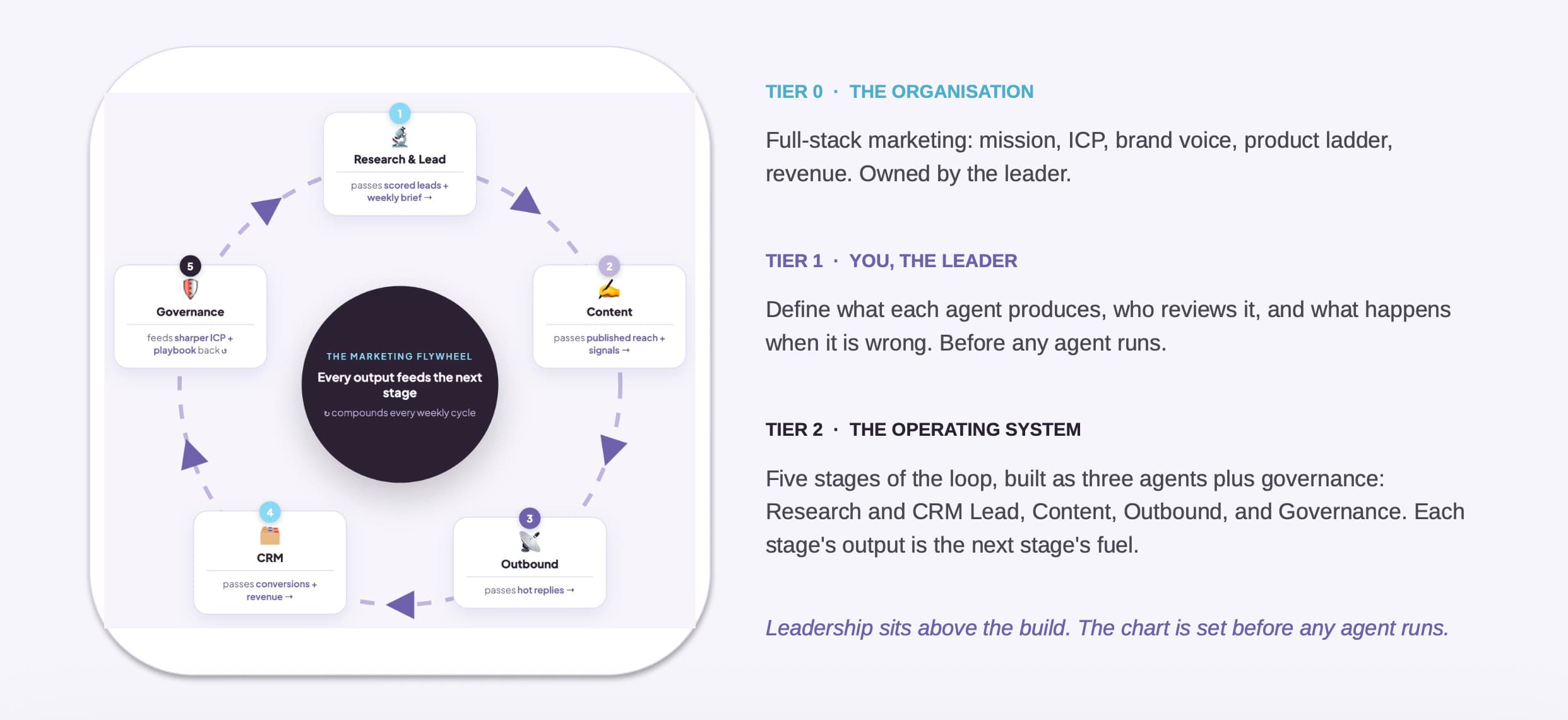
The shift I am watching right now is not about better prompts or smarter templates. It is about what happens when each stage of the loop becomes a standing system. Something that runs continuously, surfaces what matters, and waits for your judgment at the decision point.
That is agentic MAPE. And it changes the GTM calculus completely.
Here is what each stage looks like when the agent does the work.
The MAPE Loop for marketing, GTM, and growth is explored in depth in an upcoming Agentic AI event, where we share strategy and live-build each stage of the loop into a working system.
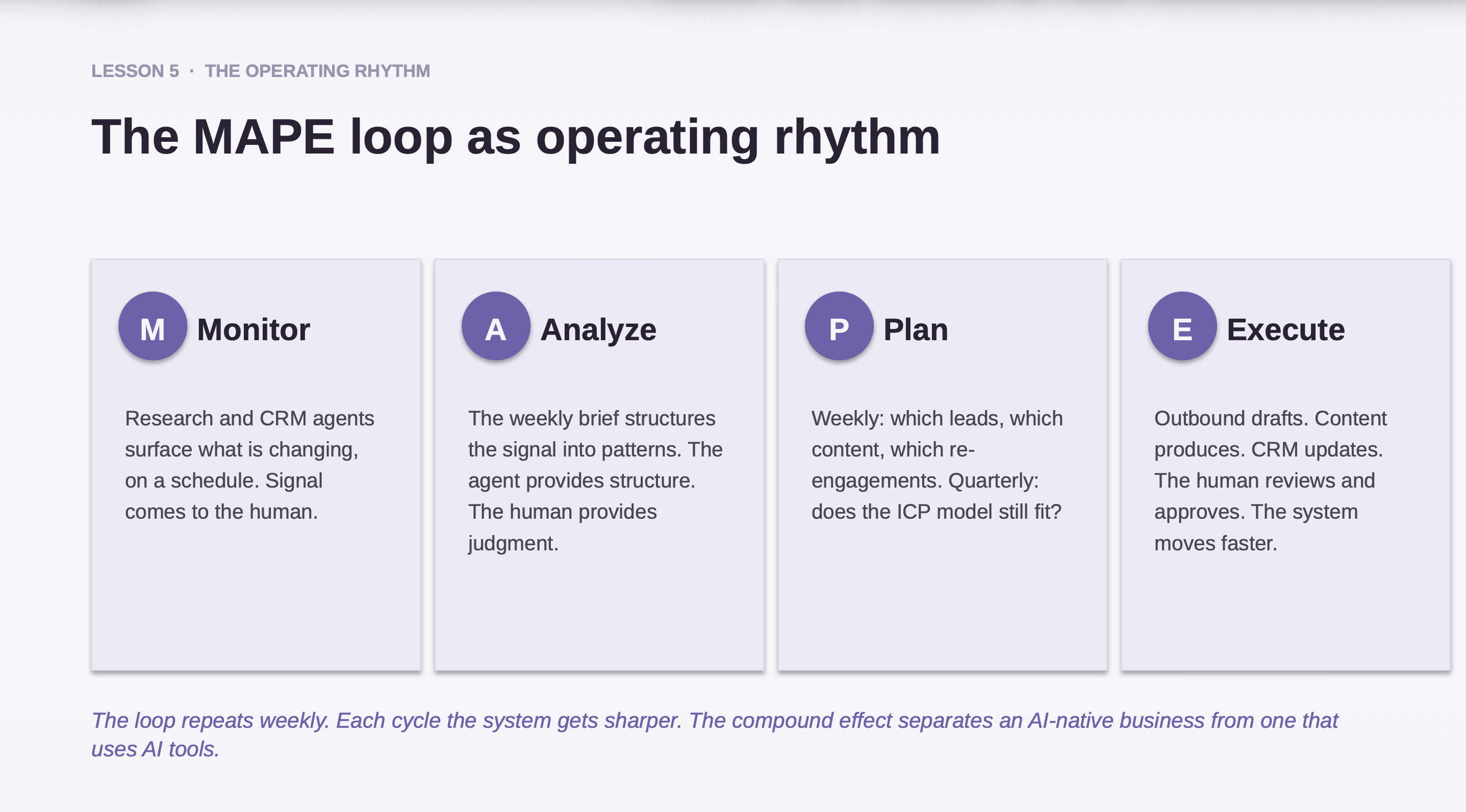
A single prompt is useful. A system is transformational.
The MAPE Loop connects your prompts into a repeatable Marketing & GTM engine that monitors market signals, analyses patterns, plans experiments, and executes campaigns.
Each cycle feeds the next.
Over time the system gets smarter as your market evolves.
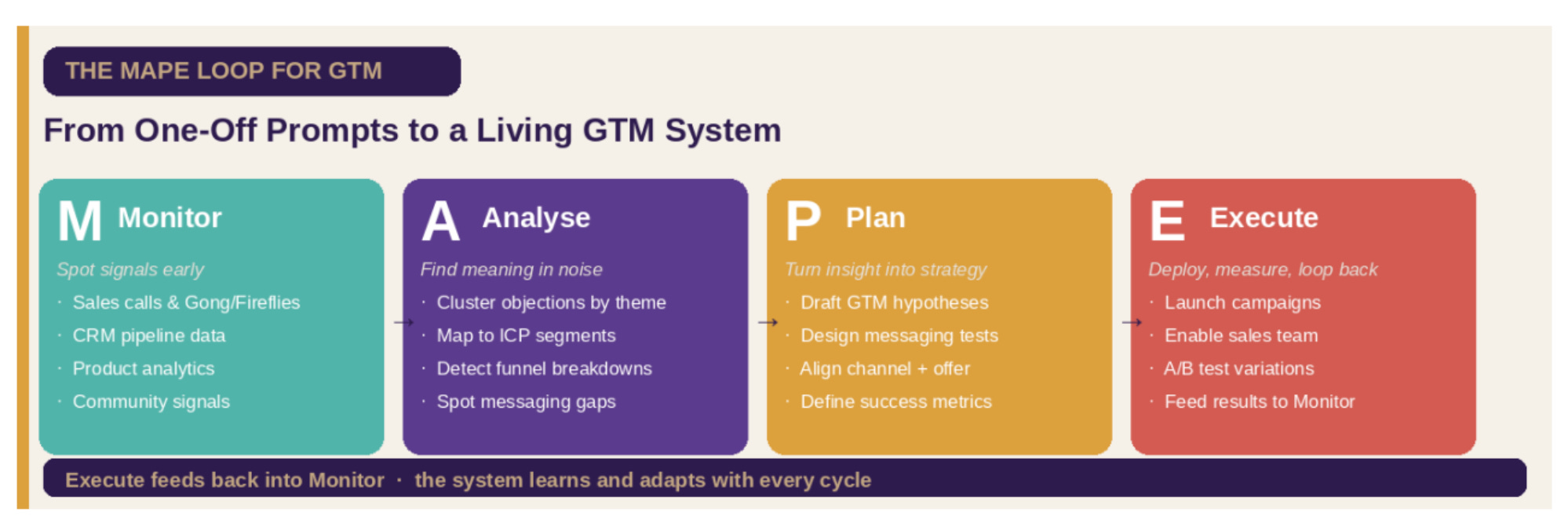
MAPE
[M] Monitor
Monitor: you stop collecting, you start reviewing
In a manual setup
Monitoring is your job. You pull meeting / call transcripts. You skim the CRM. You notice that three prospects this week mentioned the same competitor. You flag it in a doc somewhere.
In an agentic setup
The monitoring layer runs in the background. Call transcripts get processed the moment they land. Pipeline anomalies surface before the weekly sync. Competitor signals get caught without a search.
By the time you open your laptop, the patterns are already waiting.
You are not monitoring anymore. You are reviewing what the system noticed.
SIGNAL SOURCES TO MONITOR
• Sales calls and customer conversations (Fireflies, Granola transcripts)
• CRM pipeline data: stage velocity, transaction / deal size, win/loss patterns
• Product analytics: feature adoption, drop-off points, usage patterns
• Community signals: what is being discussed, shared, complained about
• Competitor moves: new features, pricing changes, messaging shifts
MONITORING PROMPTS TO USE
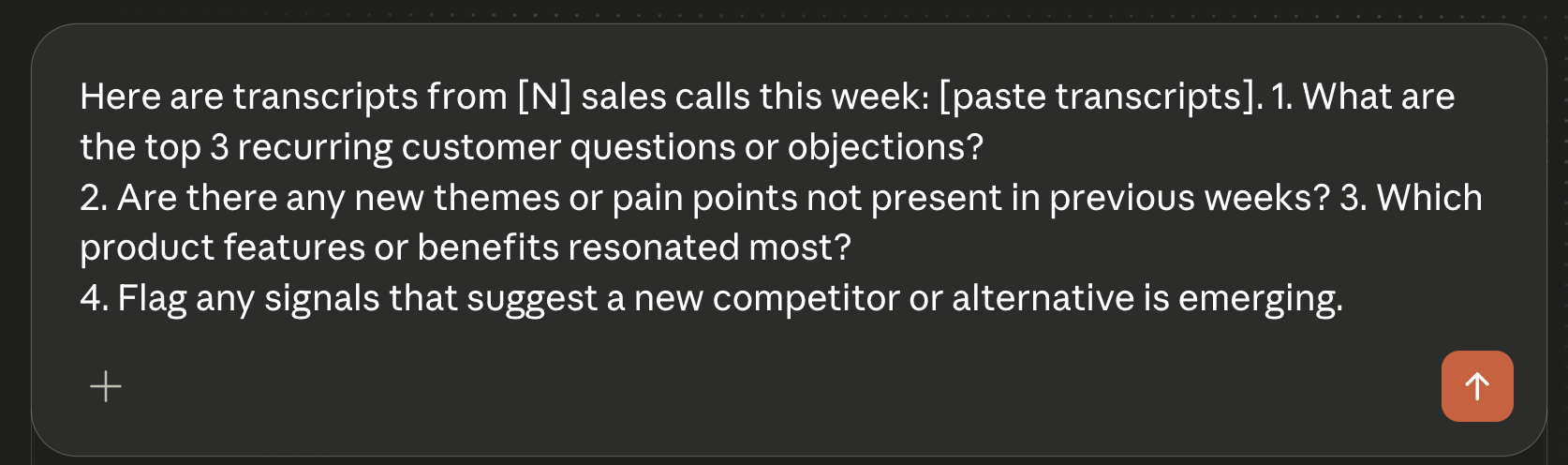
Signal extraction prompt:
Here are transcripts from [N] sales calls this week: [paste transcripts].
1. What are the top 3 recurring customer questions or objections?
2. Are there any new themes or pain points not present in previous weeks?
3. Which product features or benefits resonated most?
4. Flag any signals that suggest a new competitor or alternative is emerging.
[A] Analyze
From a weekly meeting to a standing diagnostic
The past version of analysis
Analysis used to live in a slide deck. Three hours to build. One hour to present. Two weeks to act on. By the time the insight reached the team, the window to respond had already passed.
The agentic version
The agentic version runs a standing diagnostic. The same questions get asked of fresh data every week: where are qualified leads stalling, which messages are resonating, what objections are clustering. The agent writes the first answer. You read it and decide what matters.
This is not a summary. It is a live read on the health.
WHAT TO ANALYSE
• Customer segment shifts: is a different type of buyer showing up? Are they converting faster or slower?
• Conversion bottlenecks: where are qualified leads stalling in your funnel? • Messaging adoption: which messages are reps using in calls and which are they ignoring?
• Objection patterns: are the same objections clustering around a specific feature gap or price point?
ANALYSIS PROMPTS TO USE
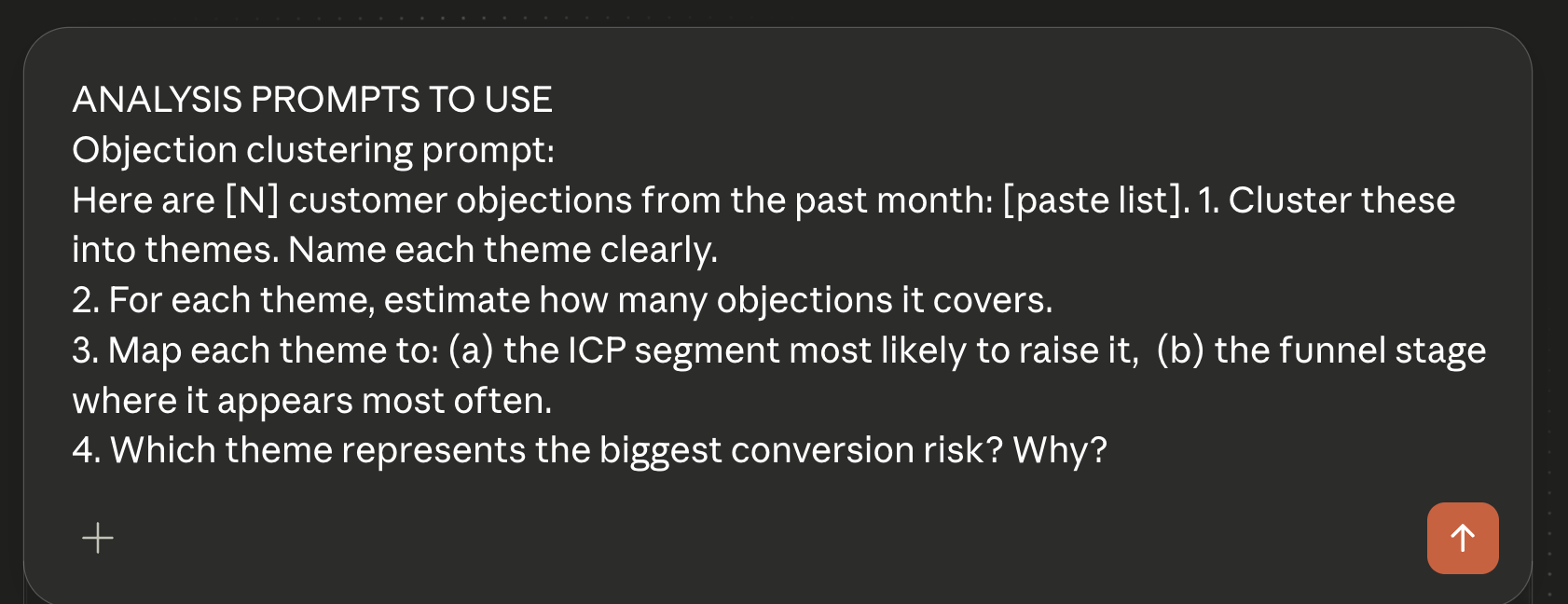
Objection clustering prompt:
Here are [N] customer objections from the past month: [paste list].
1. Cluster these into themes. Name each theme clearly.
2. For each theme, estimate how many objections it covers.
3. Map each theme to: (a) the ICP segment most likely to raise it, (b) the funnel stage where it appears most often.
4. Which theme represents the biggest conversion risk? Why?
[P] Plan
From strategy sessions to testable decisions
What planning used to be
Planning is where most teams lose the most time. They confuse planning with alignment. They hold a session, produce a document, and debate the document for two weeks before anything gets tested.
Agentic planning
Agentic planning looks different. The system surfaces three testable hypotheses from the analysis. Each one is specific: the message, the channel, the audience segment, the success metric. You pick one. The test runs.
No deck. No sync. One decision per week.
Planning is where analysis becomes action. The output of good planning is not a strategy document. It is a set of testable hypotheses: specific changes to messaging, channel, offer, or onboarding that you can validate quickly with real data.
WHAT GOOD PLANNING PRODUCES
• Three GTM hypotheses, each with a specific predicted outcome
• A small-scale test for each hypothesis: the messaging, the channel, the audience, and the success metric
• A prioritisation decision: which test to run first and why
PLANNING PROMPTS TO USE
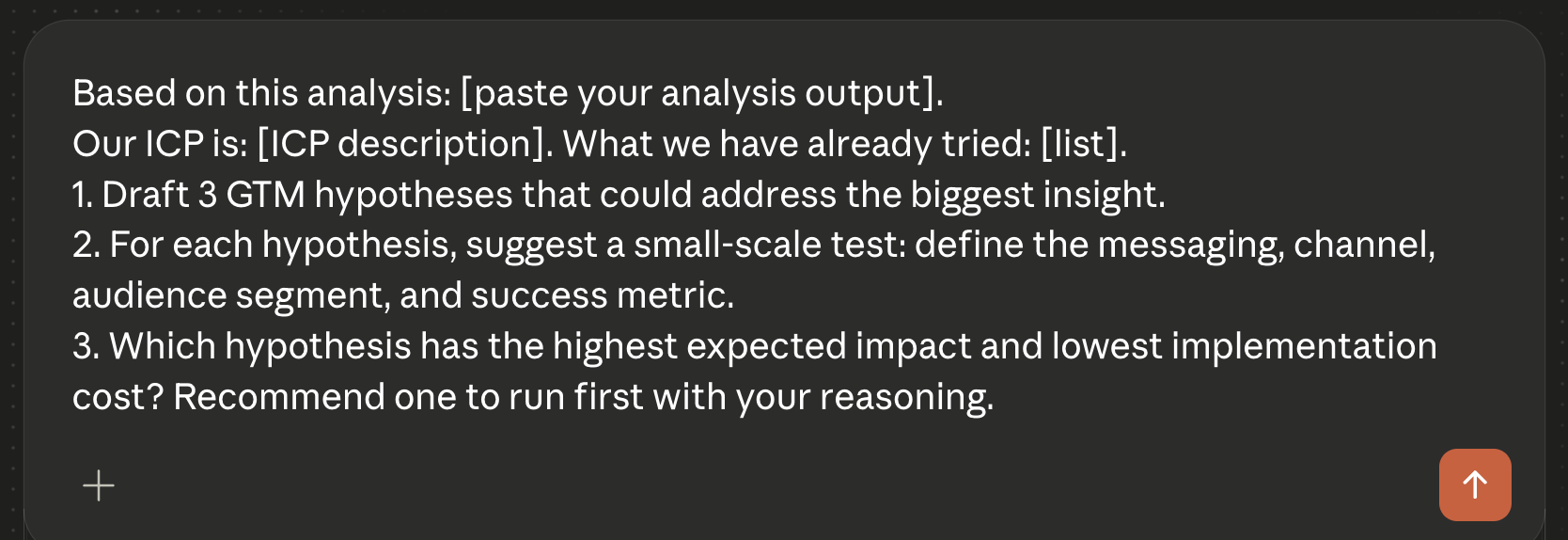
GTM hypothesis prompt:
Based on this analysis: [paste your analysis output].
Our ICP is: [ICP description]. What we have already tried: [list].
1. Draft 3 GTM hypotheses that could address the biggest insight.
2. For each hypothesis, suggest a small-scale test: define the messaging, channel, audience segment, and success metric.
3. Which hypothesis has the highest expected impact and lowest implementation cost? Recommend one to run first with your reasoning.
[E] Execute
Deploy, Measure, and Feed Back Into the Loop
Execution used to be a sprint.
Build assets, launch the campaign, wait six weeks for results.
Agentic version
Now it is a loop. The agent generates outreach variations, runs A/B tests, and produces a performance report against each hypothesis. The results feed back into the Monitor stage automatically. The loop closes.
You are not launching campaigns anymore. You are approving drafts and reading results. Execution is where the insight becomes revenue.
AI helps here too: generating personalized outreach, creating A/B test variations, drafting campaign assets, and building reporting that feeds results back into the Monitor stage automatically.
EXECUTION TASKS AI ACCELERATES
• Personalized outreach at segment level: generate variations for each ICP cluster
• A/B test asset creation: headline variants, subject line tests, CTA alternatives
• Campaign reporting: summarize results against the hypothesis and flag anomalies
• Reengagement campaigns: identify segments showing high intent but low engagement and generate tailored sequences
EXECUTION PROMPT TO USE
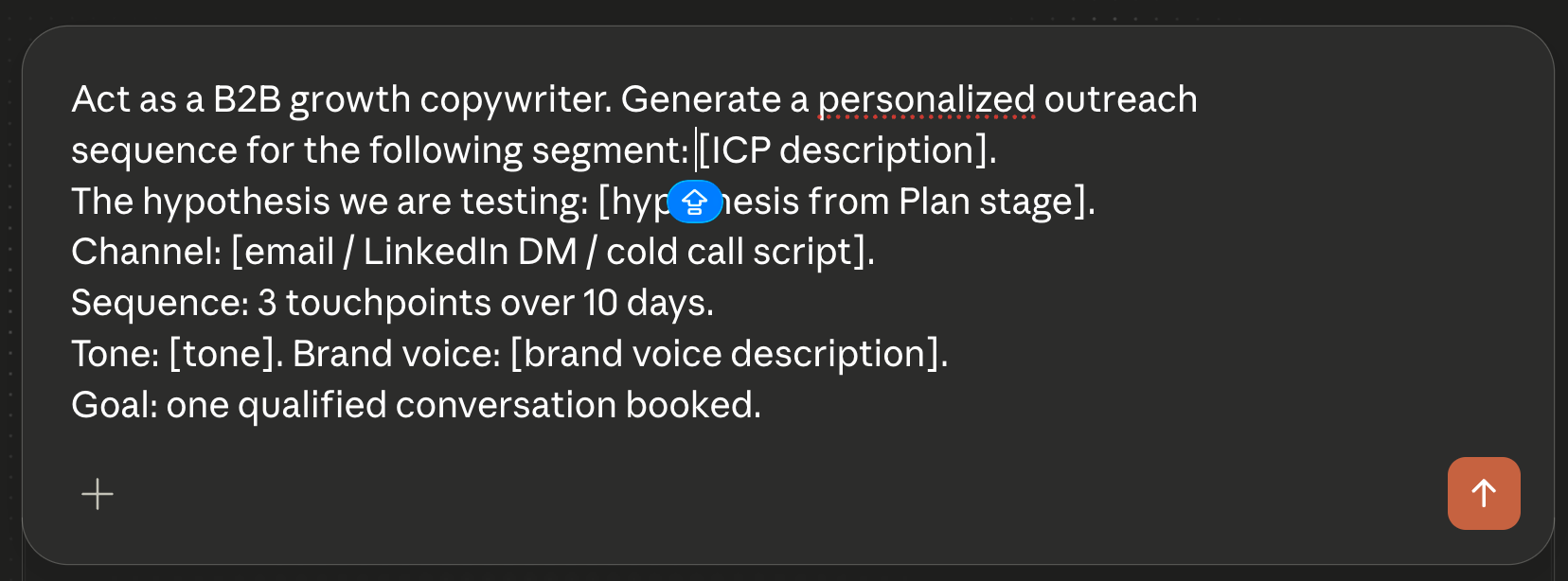
Personalized outreach prompt:
Act as a B2B growth copywriter. Generate a personalized outreach
sequence for the following segment: [ICP description]
The hypothesis we are testing: [hypothesis from Plan stage].
Channel: [email / LinkedIn DM / cold call script].
Sequence: 3 touchpoints over 10 days.
Tone: [tone]. Brand voice: [brand voice description].
Goal: one qualified conversation booked.
What you still own
None of this removes your judgment. It concentrates it.
The agent runs the loop.
You review the diagnostic, pick the hypothesis, and approve the message before it goes out. Every outbound touchpoint still passes through your eyes. Every strategic call still gets your decision.
The shift is not from human to AI. It is from you-as-operator to you-as-reviewer. That is a better use of the judgment you have built over years.
We’ll be covering a deep dive of the agentic MAPE framework in upcoming events, building a working agentic system across marketing, growth, and CRM sales that drives business transactions and deals.
That’s it for this week.
See you next time.
Grace Man,
Founder, AI Strategy League | Ex-Microsoft
Workshop starts June 16, 20, and 25
Build no-code marketing agents in Claude Code & Cowork
Use code LS03 for $60 off at checkout.
Weekly practical insights to help you architect and build agentic AI marketing, growth, and CRM systems that compound over time. Join 2k+ subscribers from Google, Microsoft, Meta, and more.
If this was valuable for you and you like to support Grace | AI Strategy League: