Set up a content agent that sounds like you
Your feed is full of AI content now. Competent, confident, and completely forgettable. In 45 minutes I show you how to build an agent that sounds like you and actually converts, and why that is a strategy question before it is a prompt question.
The session already ran. Watch the replay anytime, and grab the framework in the newsletter.
What you will learn today
- How B2B buyers actually decide now, and why memory and trust beat lead capture
- The five strategy decisions that make content sound like you and convert
- The voice system you govern: a file, an agent, an evaluator, and you as the gate
- How a second agent evaluates your content agent against your voice and brand
- Why context files are the foundation of every agentic AI workflow you build
Who I am

Grace Man
Founder, AI Strategy League
- 1
Creative Director
Hyundai
- 2
Digital Marketing Manager
Pfizer
- 3
Marketing for M365, Surface, and Xbox
Microsoft
- 4
AI Adoption Lead and Data Analyst
Canon
- 5
Founder, agentic AI for marketing, growth, and CRM
AI Strategy League
Sounding like you is not a style. It is a strategy.
It is your point of view, your real words, and who you are for. The agent just runs it at velocity, with you as the only approval gate. Here is the spine of the whole session.
“AI can copy your words. It cannot copy your point of view. In 2026 your point of view is the product, and the agent is just how you ship it fast, in your voice, with you as the gate.”
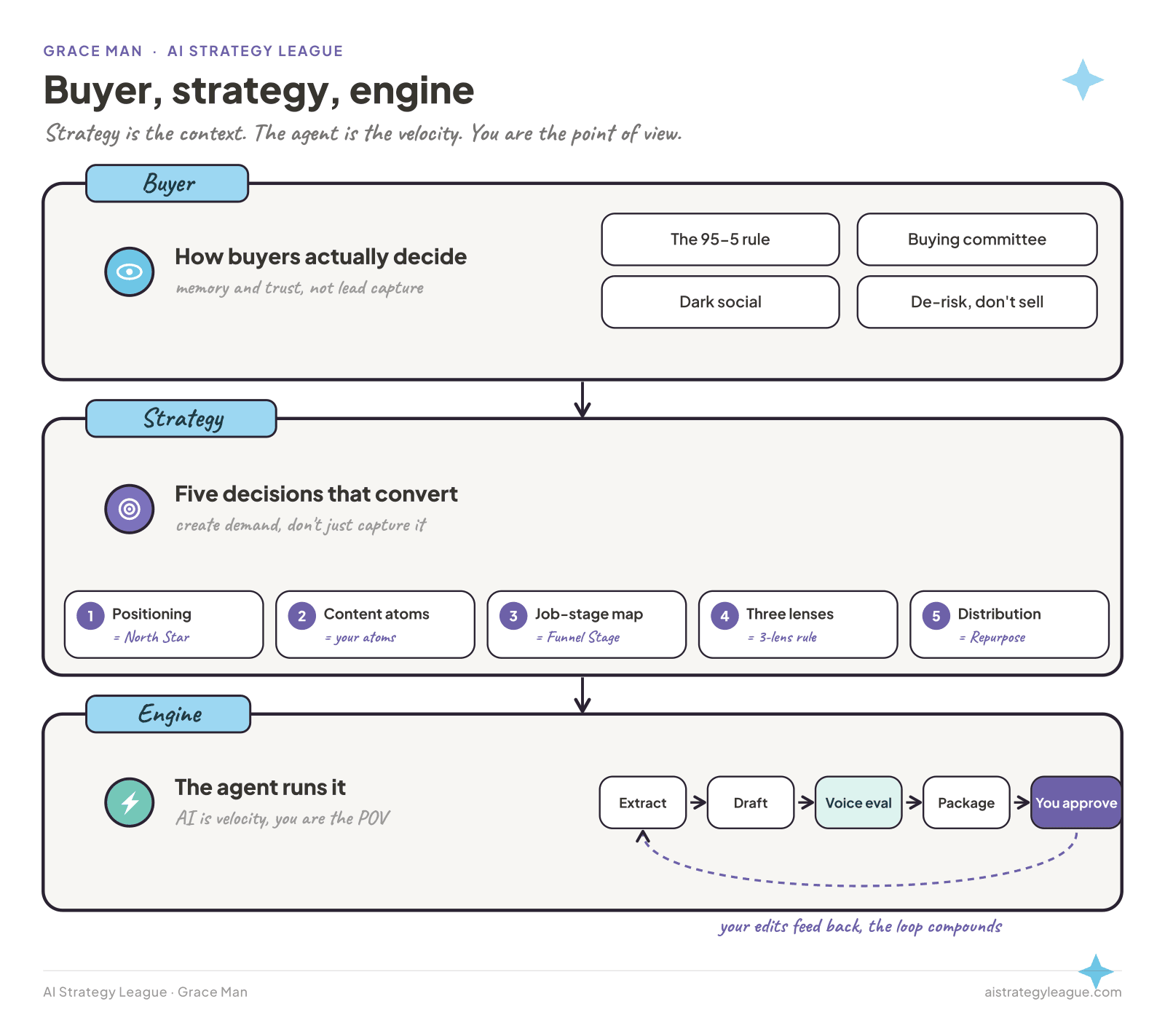
Buyer, Strategy, Engine. Understand how buyers decide, decide what to say and why it converts, then run it through an engine that drafts, evaluates, and never sends without you.
How B2B buyers actually decide now
You cannot write content that sounds like you and converts until you accept who you are writing for and what state they are in. Five truths, each one changes what you make.
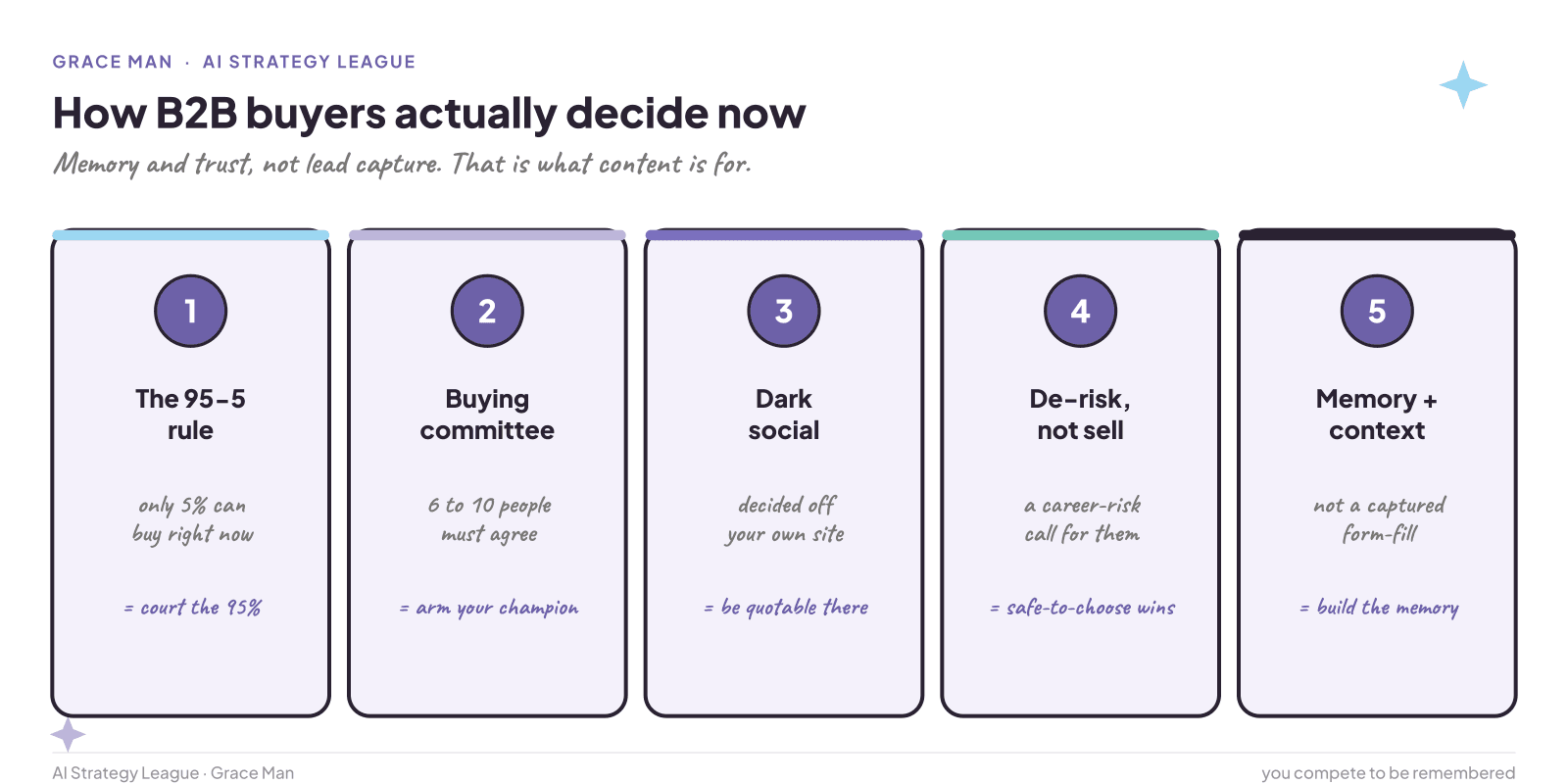
The 95-5 rule
Only about 5% of your market can buy this quarter, no matter how good your call to action is. The other 95% cannot yet.
Takeaway. Stop aiming every post at the 5%. Write for the 95% who cannot buy yet, because that is where memory and the pipeline you close next year are built.
The buying committee
You are not convincing one person. Six to ten stakeholders each research alone and must agree internally before they agree with you.
Takeaway. Write what your champion can forward to sell you when you are not in the room, not just a pitch aimed at them.
Dark social
67% of buyers prefer to buy rep-free. They form their opinion in the feed, in Slack, and on podcasts, before they ever reach your site.
Takeaway. Stop optimizing the last click. Be present and quotable where the decision actually happens, off your own site, where your CRM cannot see it.
De-risk, do not sell
A B2B purchase is a career-risk decision for the person who champions it internally.
Takeaway. Clever does not convert, safe-to-choose does. Lead with proof, specifics, and a clear point of view so picking you feels like the low-risk call.
Memory and context, not capture
Buyers decide on memory and trust, not a captured form-fill. This is the same principle you use to build an agent. You give Claude memory and context so it understands you and produces work that sounds like you. You do exactly the same for your buyer.
Takeaway. Build a memory layer with your buyer. Content is the context and memory that makes you familiar and trusted over time, so they arrive ready to buy, not cold. Do not just capture a lead and hope it converts. Build the memory, and the trust compounds, the same way context makes an agent better every time it reads it.
“You are not competing for a sale today. You are competing to be remembered on the day the buyer is finally allowed to buy.”
So the job of content is not to capture a lead. It is to be remembered and trusted by the 95% who cannot buy yet. And you get remembered by having a point of view, in a voice they recognize. That is what sounding like you is actually for.
Five decisions that make content sound like you and convert
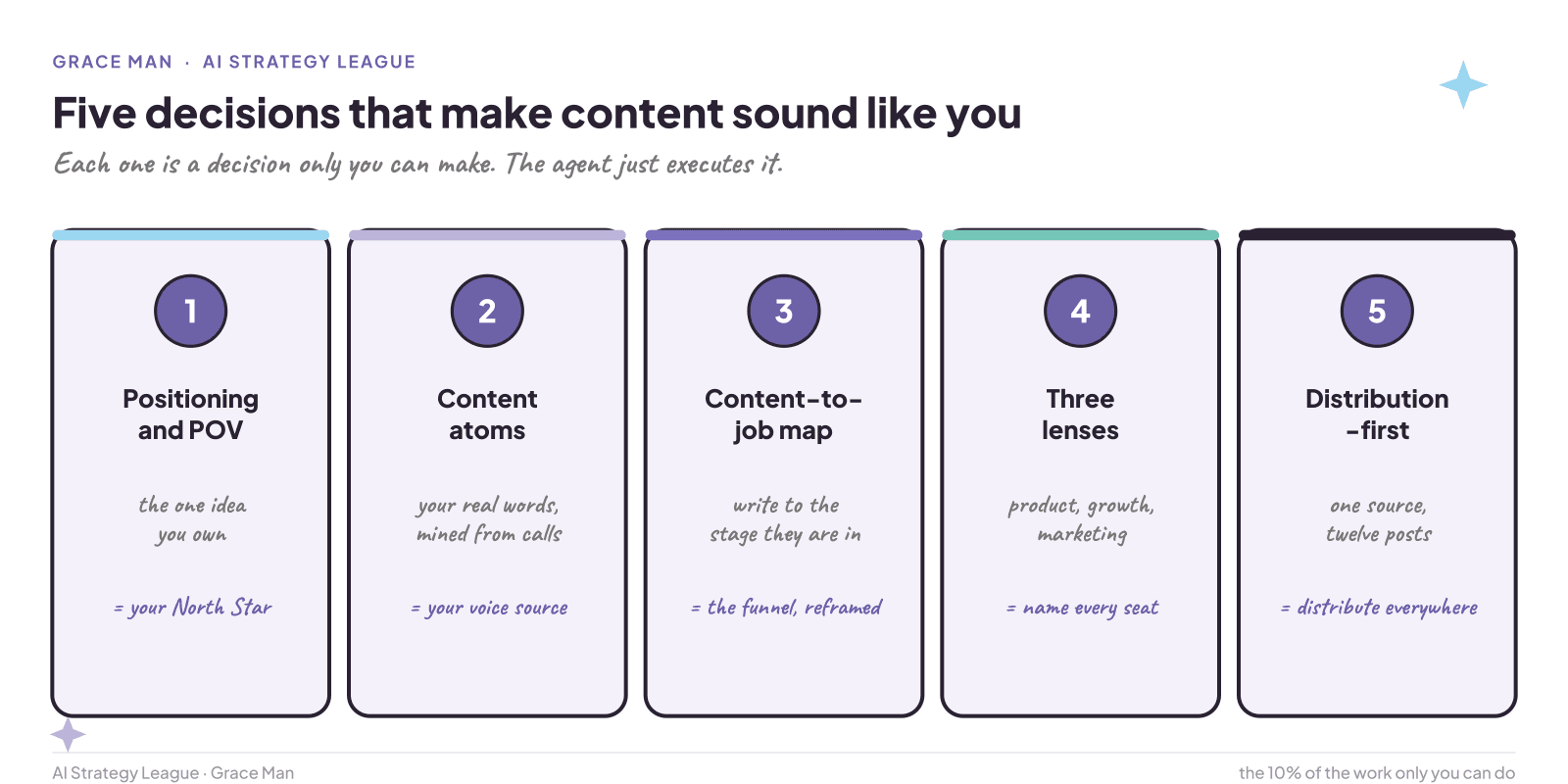
Five decisions, in order. Each one is a decision the agent then executes, but the decision is yours, and it is where the leverage is.
- 01
Positioning and point of view
Decide the frame before you write a single post, because the same expertise is forgettable in one frame and magnetic in another. Run the positioning pass once (your competitive alternative, your one unique attribute, the value it unlocks, who cares most, the category you own), then compress it to one point of view you repeat until you are known for it. It converts because every piece ends on an opinion, not a generic tip, and an opinion is the one thing an AI cannot copy from you.
- 02
Content atoms
Do not invent topics from a keyword tool. Mine your real conversations for the exact things buyers say: the recurring question, the objection they push back with, the line worth quoting. Pull eight to twenty of these atoms from your last three calls or threads. It converts because atoms carry the buyer’s own language, and that is what makes content land and actually sound like you, your real words instead of a style prompt.
- 03
Content-to-job map
Write to the job the buyer is doing and the stage they are in, not a linear funnel. Trust for the 95% (point-of-view posts and story), Discovery (guides and how-to-choose), Conversion for the 5% (proof, case studies, the internal-sell kit), and Retention (onboarding and depth). It converts because you meet the buyer where they actually are, and you publish a Trust piece and a Conversion piece in the same week, since your audience sits at every stage at once.
- 04
The three lenses
You sell to a committee, so every piece leads with one lens and names the other two: Product (activation and usage), Growth (pipeline and retention), and Marketing (brand and demand). It converts because naming the seat makes each stakeholder feel the piece was written for them, which is exactly what your champion needs in order to forward it. One primary lens per piece, all three across a month.
- 05
Distribution-first
Plan the fan-out before you write, because the pillar is the quarry, not the finished product. One source becomes one newsletter, one long post, and ten short pieces native to each channel, pushed into the feeds where the 95% actually spend their time. It converts because reach compounds when you spend more time distributing than creating. Decide the atomisation first, then write once and distribute everywhere.
None of this is a prompt. These are decisions only you can make. That is the 10% of the work that matters. The agent does the other 80.
Sounding like you is a system you govern
Everyone tries to make AI sound like them with a voice sample in a prompt. It never holds, because a prompt is a wish. What holds is a loop you govern: a file teaches the agent your voice, the agent drafts, a second agent evaluates every draft against your rules, and you approve. Then your edits feed back, so it sounds more like you every week. That loop is the engine, and it compounds.
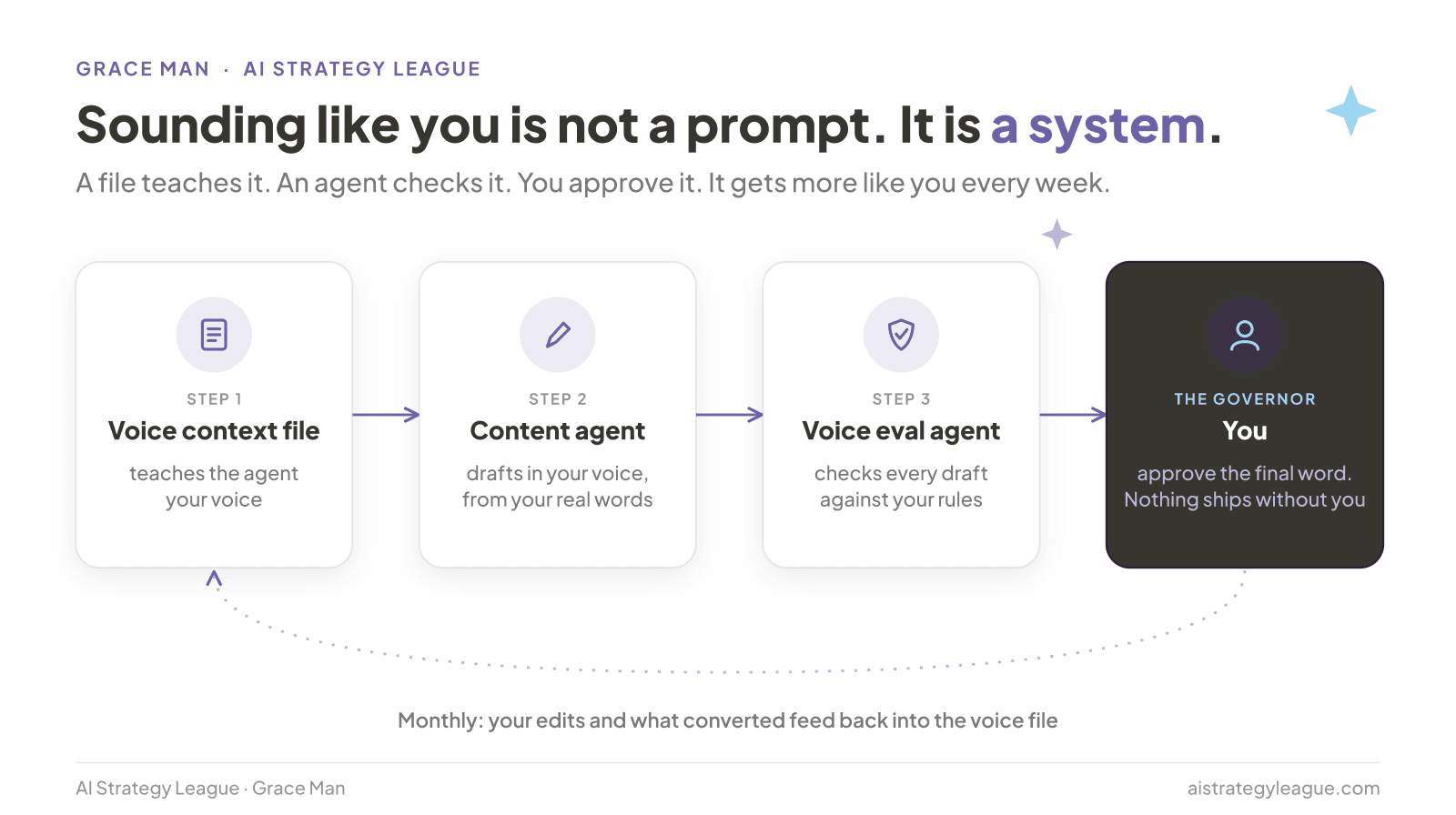
A file teaches it, an agent drafts it, a second agent checks it, and you approve it. Your edits feed back every month, so it gets more like you over time.
- 01
The voice context file
The memory that teaches the agent your voice. The agent does not guess your voice, it reads it: your identity, your influences, your banned words, your pre-publish gut check. This is a document, not a prompt, and that is why it holds.
- 02
The content agent drafts
In that voice, from your atoms, your real words. A rough input, a meeting note or an idea, becomes a ready-to-review draft across every channel.
- 03
The voice evaluator agent
A second agent checks every draft against your red lines before it ever reaches you: no filler, a specific angle not a topic, a story from the real source, an opening that is a pain not a platitude. This is your governance partner. It does the first-pass check so you govern from the top, not by proofreading in the weeds. An agent that evaluates your content agent, tasting the soup before it goes out.
- You
You, the governor
Operator, Reviewer, Approver, and you are the Approver. Nothing ships in your name without you. Then your edits and what actually converted feed back into the voice file every month, so the loop sounds more like you over time and needs you less for the small things.
“AI is the velocity. You are the point of view. The gate is not a safety feature. It is where your voice lives.”
How do you keep every agent on brand and in your voice?
This one is the foundation everything else sits on. Before you build a single agent, you set up your context files. A few short documents: who you are, how you write, your brand, what you sell, and the rules every output must follow. Claude reads them before every brief, post, or DM, so the work comes back sounding like you and looking like you, without you fixing it each time.
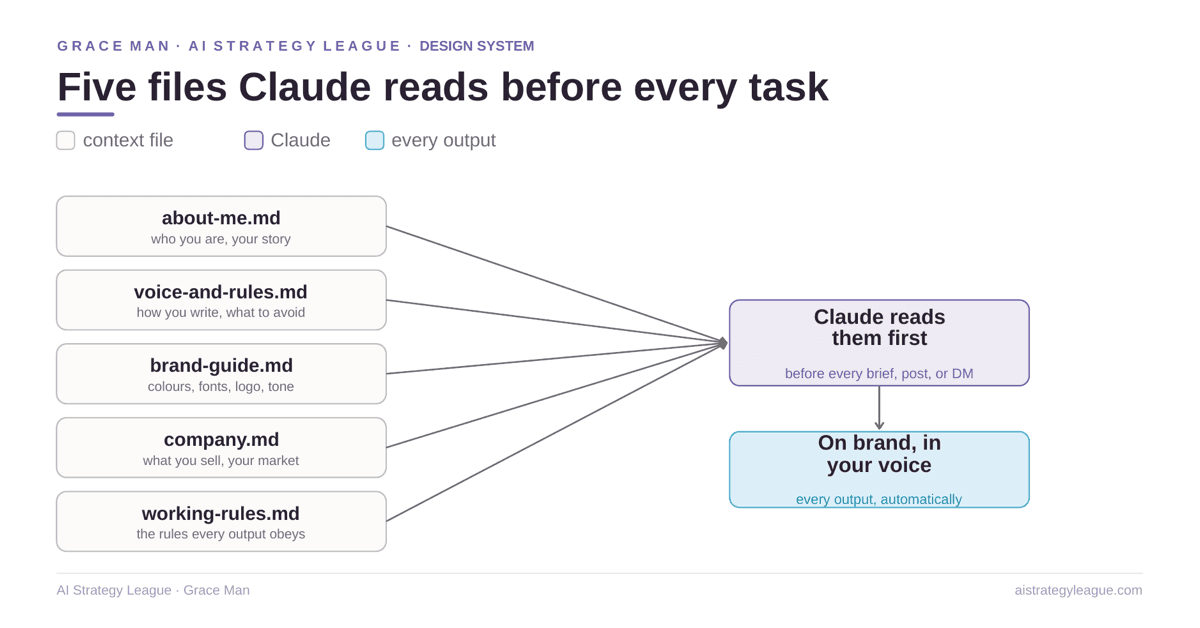
Your context layer and memory. The setup every agent reads before it does anything. This is where being on brand and in your voice actually comes from.
Context is the most important layer in any agentic AI workflow. Get it right once, and every agent you build on top inherits it. Skip it, and you get generic AI that you spend hours editing back into shape.
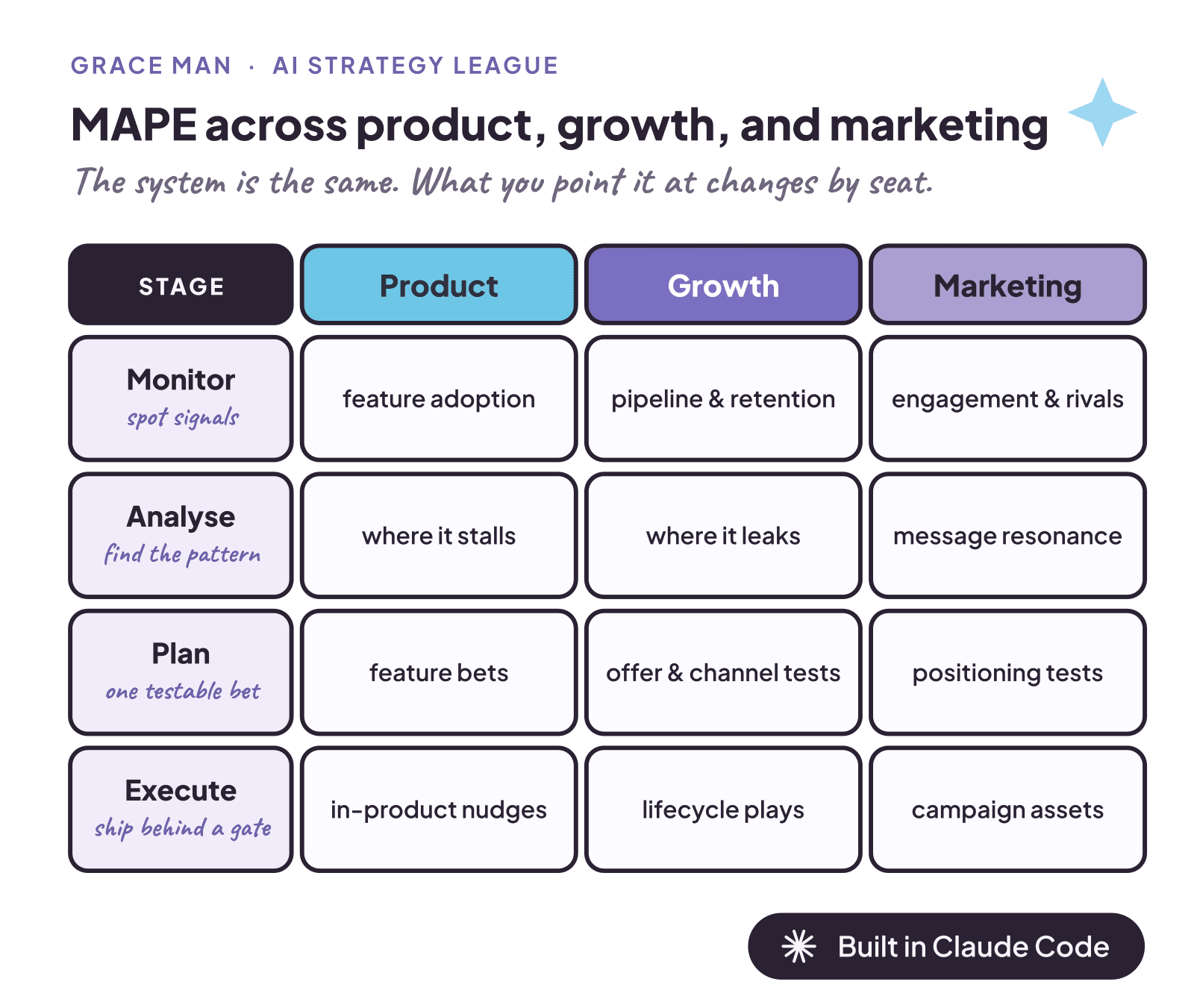
That is your design system. Set it up once, and every agent you build on top stays on brand and in your voice.
“Before you build a single agent, you set up your context files. That is the foundation everything else sits on.”
What we covered, before you build it
The whole session on one screen. This is the thinking you take with you.
- 01
The buyer
Buyers decide on memory and trust, not a captured form-fill. Build a memory layer with them, the same way you give an agent context, and the trust compounds instead of expiring.
- 02
The strategy
Five decisions that make content sound like you and convert: positioning and point of view, content atoms, the content-to-job map, the three lenses, and distribution-first. The 10% only you can do.
- 03
The engine
A voice system you govern: a file teaches the agent your voice, the agent drafts, a second agent evaluates every draft against your rules, and you approve. Your edits feed back, so it compounds.
- 04
The foundation
Context files are the layer everything sits on. Set them up once, and every agent you build on top stays on brand and in your voice, without you fixing it each time.
“The agent makes you faster. It does not make you worth reading. That part is still yours.”
The session is the thinking. The workshop is the build.
One full day, live and private to your team, up to five seats. Your team architects the five growth capabilities on your own accounts and builds the first one live, on a real account someone in the room already knows. $4,500.
The agent makes you faster. It does not make you worth reading. That part is still yours.

Grace Man
I run this exact system in AI Strategy League every day: research, lead, content, outbound, and CRM, with me as the governor on every send. Before this I drove growth and marketing at Microsoft, Canon, and Pfizer, influencing more than $2B in revenue, and I have trained and coached over 3,000 professionals in AI-first product growth, with learners from Google, Microsoft, and Meta.